
Content Resources Page
Before the Show
Content Analysis
PLAY SYNOPSIS
Confident, clever, and utterly certain she knows best, Emma Woodhouse delights in orchestrating the lives—and romances—of those around her. Based on the beloved novel by Jane Austen, *Emma* follows a young woman of wit and privilege who fancies herself a skilled matchmaker in her quiet English village. Having successfully paired her governess with a suitable husband, Emma turns her attention to her friend Harriet, determined to elevate her social standing through what she believes to be advantageous connections.
But Emma’s well-intentioned schemes soon create a web of misunderstandings, misguided affections, and social missteps. As she navigates flirtations, rivalries, and the ever-watchful eye of her friend Mr. Knightley, Emma begins to realize that her confidence may have blinded her to the true feelings of others—and her own heart. With sparkling dialogue, sharp social observation, and a cast of richly drawn characters, this timeless story captures both the humor and the complexity of human relationships.
Charming, insightful, and full of delightful twists, *Emma* invites audiences into a world where love is rarely straightforward and self-discovery comes at a cost—leaving one lingering question: who truly understands the heart best?
CHARACTERS
EMMA (late 20s–30s):
Charming, witty, and endlessly confident, Emma is a clever social manipulator with a flair for matchmaking. Wealthy and highly educated, she’s ambitious, impulsive, and often overestimates her own insight, but her warmth and humor make her deeply lovable.
HARRIET SMITH (20s):
Sweet, eager, and impressionable, Harriet is a kind-hearted young woman who longs for love and belonging. She admires Emma deeply and tends to follow wherever others lead.
MRS. WESTON (mid 30s–40s):
Emma’s former governess and trusted friend. Smart, grounded, warm, and perceptive, she offers wise advice with humor and honesty.
MRS. BATES (70s+):
An eccentric elderly woman hidden beneath layers of scarves and shawls, communicating mostly through grunts and gestures.
MISS BATES (40s+):
A talkative, good-natured schoolmistress who adores her niece Jane Fairfax and rarely pauses long enough for anyone else to speak.
JANE FAIRFAX (20s–30s):
Elegant, intelligent, and seemingly perfect, Jane is composed and accomplished, though she quietly hides deep emotions and a secret romance.
MRS. ELTON (20s–30s):
Loud, overenthusiastic, and blissfully self-important, Mrs. Elton is convinced her husband is irresistible and delights in everything around her.
MR. KNIGHTLEY (30s–40s):
A thoughtful, intelligent gentleman with strong principles and a dry sense of humor. Though sometimes stubborn, he deeply cares for Emma and ultimately learns to embrace vulnerability.
MR. WOODHOUSE (60s+):
Emma’s anxious but lovable father, a chronic worrier obsessed with health, gruel, and predicting illness.
MR. WESTON (40s–50s):
A cheerful, good-hearted man prone to awkward jokes and enthusiastic matchmaking. Proud of his son Frank Churchill.
MR. ELTON (any age):
A romantic clergyman with grand ideas about love and poetry. Ambitious and overly confident in his charm, he mistakes flirtation for destiny.
FRANK CHURCHILL (20s–30s):
Handsome, witty, and effortlessly charming, Frank is a flirt who enjoys attention and bending the rules. Beneath his playful nature lies genuine affection for Jane Fairfax.
ROBERT MARTIN:
A sincere and kind groundskeeper deeply in love with Harriet. Non-speaking role.
THEMES
Love and Matchmaking
At the center of the play is Emma Woodhouse’s confidence in her ability to arrange romantic relationships for those around her. The story explores the difference between genuine love and social ambition, as well as the unintended consequences of meddling in other people’s lives.
Class and Social Status
The play examines class distinctions and social expectations in Regency England. Characters frequently discuss marriage, financial stability, education, reputation, and social mobility. Emma’s assumptions about who is “appropriate” for Harriet reveal the pressures and prejudices of the era.
Friendship and Personal Growth
Emma’s relationship with Harriet and her ongoing clashes with Mr. Knightley highlight themes of maturity, self-awareness, and learning from mistakes. Over the course of the play, Emma confronts her own arrogance and begins to better understand the feelings of others.
Women and Independence
This adaptation emphasizes the limited options available to women during the time period. Characters discuss marriage, education, work, and societal expectations placed upon women of different classes.
Satire and Social Comedy
The play uses exaggerated humor, witty banter, physical comedy, and direct audience address to satirize romance, manners, and societal conventions. The tone is playful, self-aware, and intentionally theatrical throughout.
CONTENT FOR PARENTAL CONSIDERATION
MATURE SUBJECT MATTER
Frequent romantic and flirtatious dialogue
Sexual innuendo and suggestive humor throughout the play
References to physical attraction, desire, and marriage
Comic discussions involving “bodice-ripping novels,” passionate romance, and flirtation
One comedic reference to a limerick beginning with “There once was a girl from Nantucket…” before being interrupted
Some suggestive jokes and modernized humor that may feel more contemporary than traditional Austen adaptations
DRINKING/ALCOHOL
Characters consume alcohol socially during party scenes
References to wine and brandy
One character jokingly seeks brandy after a stressful interaction
No depictions of substance abuse or intoxication-centered scenes
LANGUAGE
Mild adult language and comedic insults
Occasional suggestive phrasing and innuendo
No strong profanity
VIOLENCE/PHYSICAL COMEDY
Comedic physical antics, exaggerated gestures, and slapstick humor
A character dumps a vase of flower water over another character during a confrontation
No graphic violence
SPECIAL EFFECTS/SENSORY ADVISORY
Occasional loud comedic moments and exaggerated physical humor
Direct audience address and fast-paced dialogue
Brief moments of staged chaos or heightened theatricality
One scene involving water being thrown during a comedic confrontation
The production is not typically considered sensory-intensive and is appropriate for most audiences.
RUNNING TIME
2 hours and 20 minutes including intermission
SHOW DATES
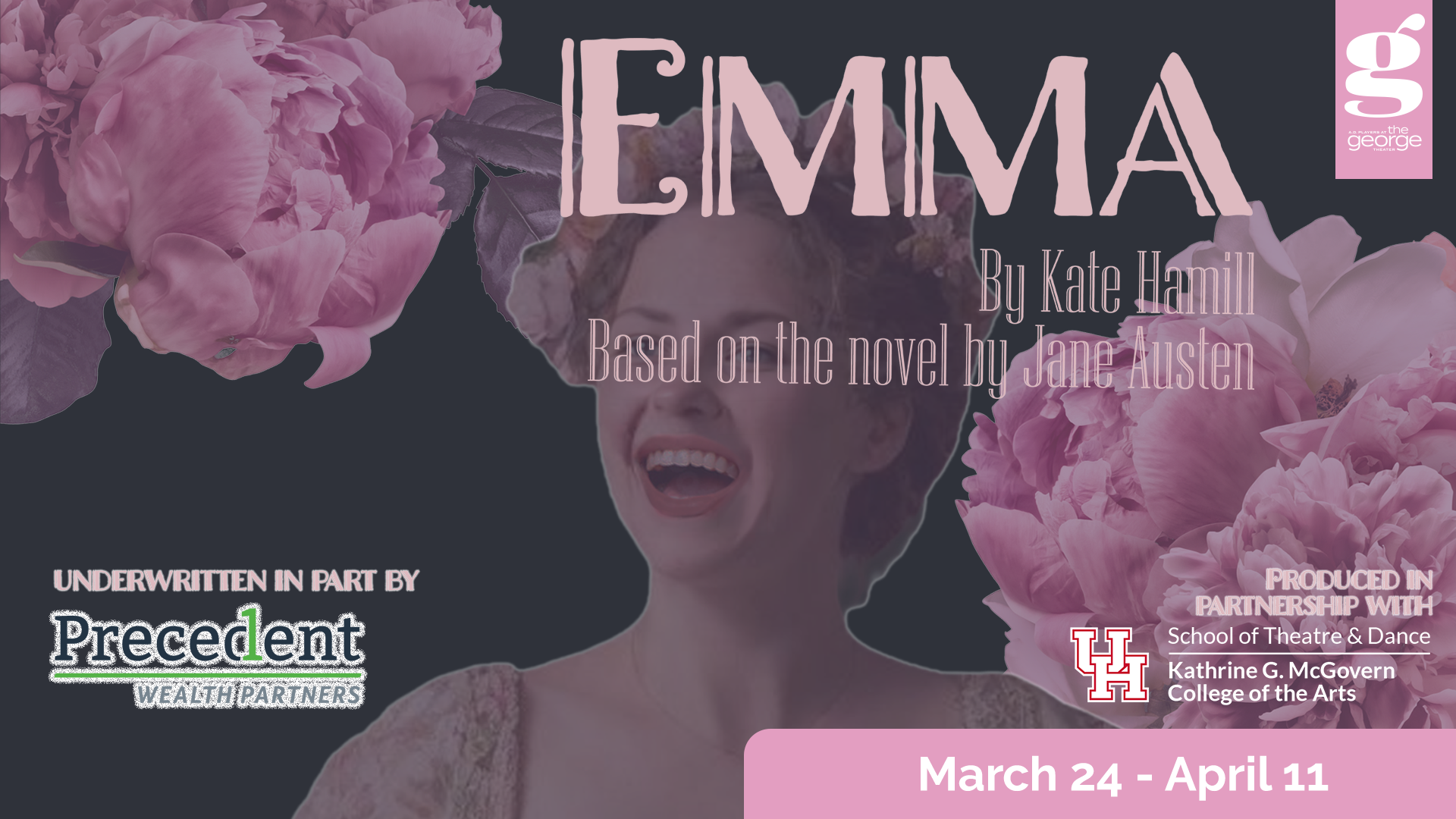
March 24 - April 11, 2027
WHAT IS THE RECOMMENDED AGE Emma?
Recommended for teens and adults due to romantic themes, suggestive humor, social satire, and mature comedic dialogue. Suitable for most audiences familiar with Austen-style romantic comedy, though this adaptation includes a more modern comedic tone and occasional innuendo.
HOW MUCH ARE TICKETS TO Emma?
Tickets prices vary between $25 and $80 depending on where you sit in the theater.
Executive Artistic Director’s Note
One of Jane Austen’s most delightful comedy of manners, EMMA, adapted for the stage by Kate Hamill, takes an anachronistic (mixing time periods), screwball comedy approach to this timeless story of a self-appointed matchmaker who can’t seem to find her own match. EMMA is part of our great works initiative, where we produce or adapt classic pieces of literature for the stage. This will also be our second higher-education collaboration of the season with the University of Houston—allowing theatre students in Houston to work with professional actors, designers, and production teams and gain valuable experience. EMMA is a delightfully funny romp through Regency-era England that is sure to leave you with a smile.
After the Show
Theatre is an art form that from its inception has had the proven power to move and to stir the human spirit. This can have a wide variety of manifestations. We are often stirred up, and that kind of event can have us needing to talk to someone about it. We recommend that you find a licensed mental healthcare professional to help you work through difficult feelings that may have been stirred up by a play. You should always work with someone that you have a great connection with. If you need help starting that process, we recommend our partners at Ellie Mental Health as a starting place.

You might also be stirred to do something about how a particular play made you feel. Below we have provided a quick link to be able to donate to us here at the A. D. Players at the George Theatre. As a 501(c)3, we rely heavily on donations to continue the work that we do. If, however, you want to do something meaningful about some of the issues addressed by our shows, we are also including links to organizations that do meaningful work in the areas addressed by the content of our show. These are not exhaustive options, but merely starting places to help you on your journey to continue to effect change in your world.
